


Internet Of Things
INTRODUCTION
Today sensors are everywhere, there are sensors in our vehicles, in our smart phones, in factories, and even in the ground monitoring soil conditions. The sensors have been around for a while, research on wireless sensor networks (WSNs) started back in the 1980s, and it is only since 2001 that WSNs generated an increased interest from industrial and research perspectives. This is due to the availability of inexpensive, low powered miniature components like processors, radios and sensors that were often integrated on a single chip.
The internet of things (IoT) was developed in parallel to WSNs. The term internet of things was devised by Kevin Ashton in 1999 and refers to uniquely identify able objects and their virtual IoT does not assume a specifi c communication technology, wireless communication technologies will play a major role, and in particular, WSNs will proliferate many applications and many industries.
The small, rugged, inexpensive and low powered WSN sensors will bring the IoT to even the smallest objects installed in any kind of environment, at reasonable costs. Integration of these objects into IoT will be a major evolution of WSNs.
IOT SOLUTION ARCHITECTURE

FRONT END SYSTEMS
Gone are the days where valuable data is sitting in one single place, isolated, and difficult to retrieve.
With IoT (Internet of Things) technology, virtually all devices, big and small, can report their status and useful information back to the Cloud, and be accessible from the Internet.
It also enable remote control of the devices.
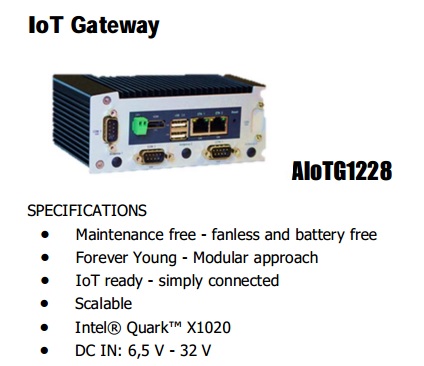
IoT Gateways in our solution have the following strength and advantages:
i. Powered by Intel processor (Quark & Atom), low energy requirement and yet powerful.
ii. Operated in Wind River Linux operating system, reliable and robust.
iii. Intel Amelia Creek controller platform.
iv. Small footprint.
v. Maintenance free.
vi. Data pushing to the server by using MQTT data packet, small bandwidth requirement, saving network data cost.
vii. Customizable to capture various kind of data from sensors.
viii. Remote control via Internet Maintenance free AIoTG1228 The AIoTG1228, based on Industrial embedded Box Controller footprint.
The “wartungsfrei” design of the AIoTG1228 includes a fanless, battery free and soldered memory (memory down) conception, which makes the AIoTG to the ideal all-lockable Box PC for the industrial environment.
Based on this technology, AIoTG1228 increases the flexibility, serviceability and cost efficiency for various applications, such as industrial automation, communication or transportation
BACK END SYSTEMS
Web-based portal, resting on HTML5 and Java script for interactivity and great user experience.
Accessible from most commonly used devices/gadgets, such as
computers, laptops, tablets, smart phones.
Data is stored in Cloud data centre, powered by Big Data
technology.
Deployed once, Access anywhere and anytime!
Our system consists of several applications which can be used in different industries:
1. Water Gate Management
Paddy fields, water treatment plants, Non-Revenue Water
management
2. Energy Management
Office buildings, shopping complex, commercial buildings,
residential buildings, factory.
3. Manufacturing Production Management
Manufacturing factories for light and medium industries
APPLICATION
Energy Management (AIoTG1228-E)
Real time data of the voltage, current, real power, power factor,
energy consumption.
Accumulated energy consumption.
Remote control of power switch
Water Gate Management (AIoTG1228-W)
Real time data of the gate status, water level, water flow rate.
Remote control to open or close the water gate.
Generate trend chart over a period of time.
Alarm and notification
Manufacturing Production Management
(AIoTG1228-M)
Counting of actual and reject product.
Monitor the downtime.

